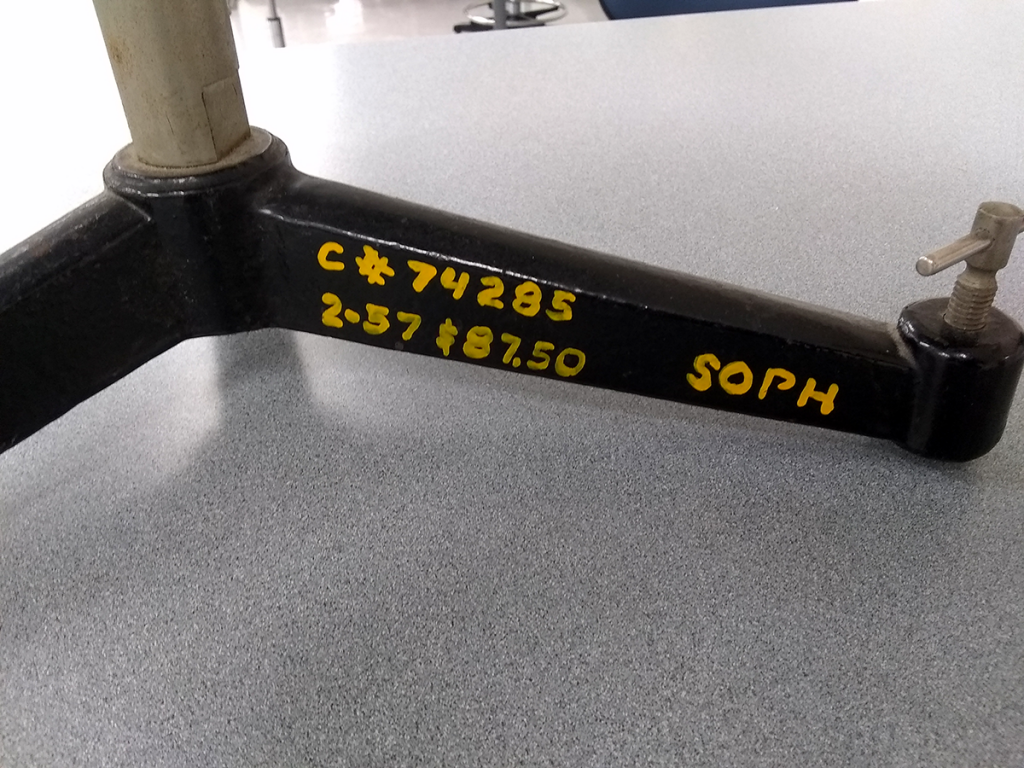
Some equipment just keeps on working, year after year. This force table – an apparatus used to illustrate static equilibrium and vectors in a way that’s loads more fun than Excel, but the students still have to learn Excel – was purchased in February of 1957 for the not-insignificant sum of $87.50.
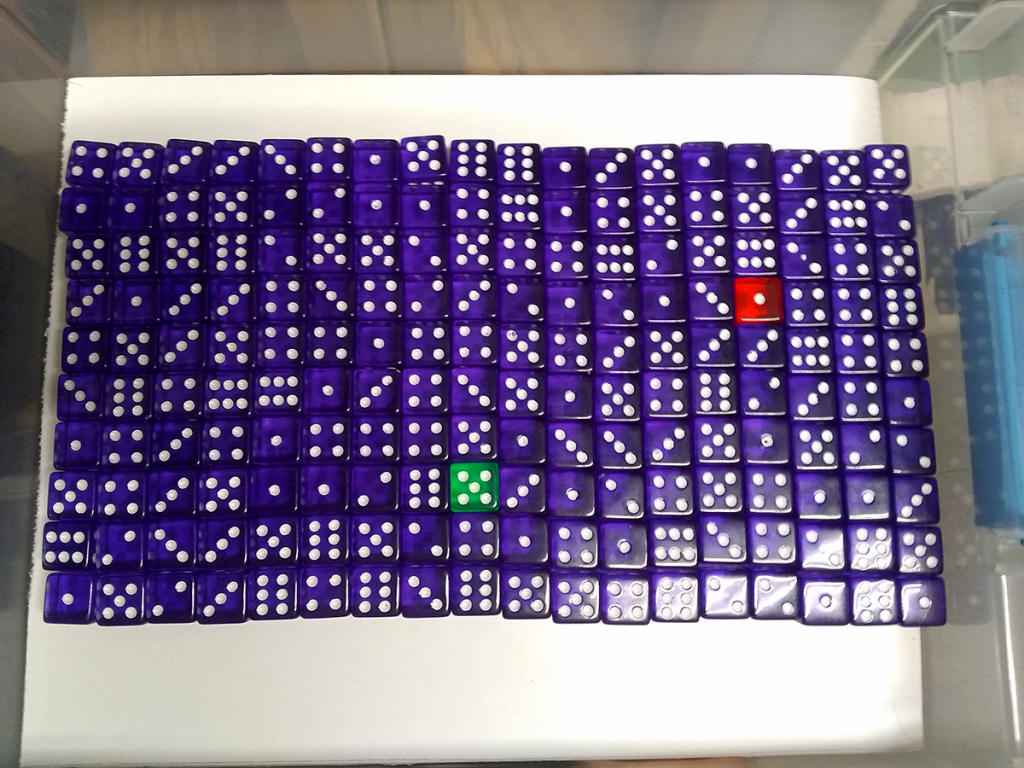
Dice! Bins of colorful dice, each with 178 of one bold color, plus two going their own way. Each bin arrayed in a 10 x 18 or 12 x 15 grid, per the shop tech’s preference at that moment. Beats counting them one by one.
Secure the lid and shake with all your might: you’re simulating radioactive decay! Loudly.
Pick a number from one to six. Say, three. Each die that turns up with three pips after a shake decays, and you remove it from the bin. With 180 dice in there, the chances of getting all threes – or zero threes – is vanishingly small. One-in-six raised to the 180th power, right? As a percentage that’s, what, nearly 140 zeros after the decimal point? Run the numbers, and you can look forward to around one-sixth of the dice in there decaying with each shake. Sometimes more, sometimes less.
You’ll also keep a close eye on those differently-colored dice. One for you, one for your partner. They’re the atoms you’re watching carefully, and unlike the sorta-predictable rolls of a large mass of dice, they’ll decay when they’re good and ready. Could be first, could be never. It’s an illustration of how probability works in systems of different sizes. Of how the random nature of radioactive decay produces a predictability with enough atoms and enough time.
In some idealized version of this experiment, you’d have 30 dice decay on the first shake. Then 25. Then 21. 17. 15. 12. 10. 8. 7. 6. 5. 4. 3. 3. 2. 2. 2. 1. 1. 1. After that… maybe one per shake? (The student experiment stops well before you’re down to a meager handful of dice.) The half-life arrives around four shakes. Every four shakes. Neat!
And should the effect with 180 dice not be enough? Compare your data to the rest of the lab, seeing how each rate of decay is nearly but not exactly the same. Then aggregate the data from all dozen lab benches. 2,160 dice decaying.
Radioactivity makes people squirm. It’s not hard to understand why. Whereas most potential dangers offer some sensory warning, radioactive materials don’t. For the most part. If your senses are picking up the direct effects of radiation, you are long past any level of safe exposure. Somehow, things have gone quite sideways for you.
But this is introductory Physics lab, and we’re here to learn in a safe environment. We’ll stick to sources that keep below the United States Nuclear Regulatory Commission’s Exempt Quantity Limit. That’s readily available in the table from § 30.71 Schedule B, which indicates the limits in microcuries [µCi] for a wide range of nuclides. In our labs, we use cobalt-60 and cesium-137 for different purposes, though you can have fun reading through the entire table to remind yourself that dysprosium, hafnium, and samarium are all on that periodic table, too.
Lots of elements struggle to become household names. Maybe it’s for the best that most of don’t have to concern ourselves with the particulars of terbium on a daily basis. (It’s key to creating the green phosphors essential to fluorescent light, so now we’ve all learned a new factoid.)
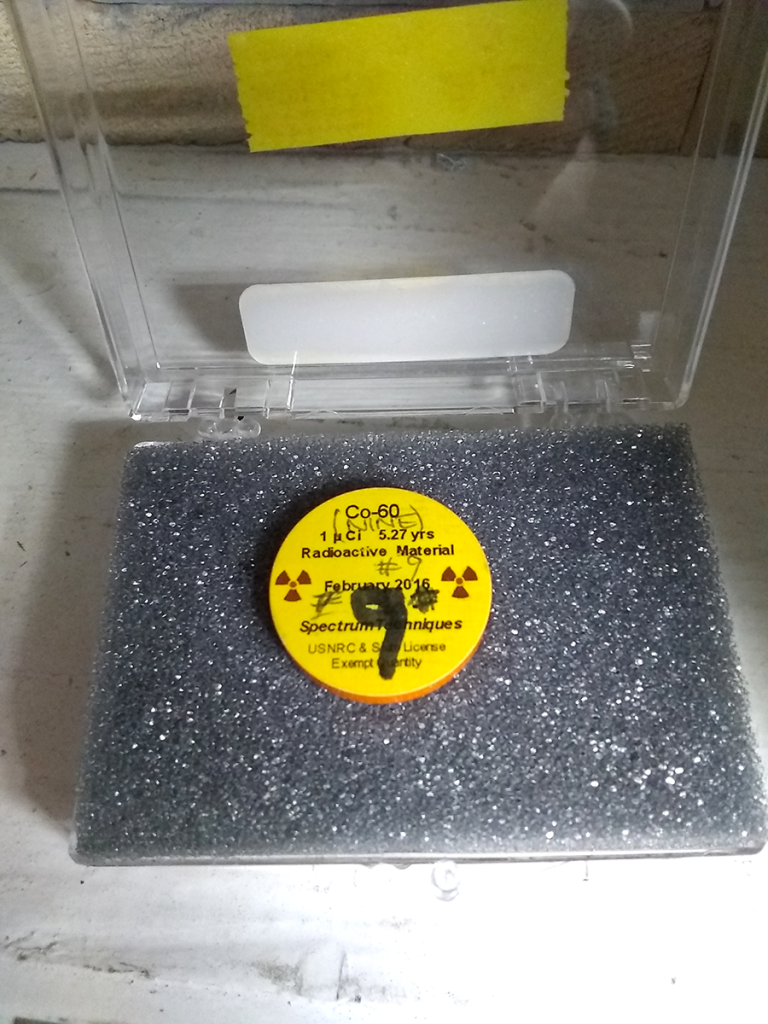
We use these little 1-inch disks as relatively constant reference sources in labs. The disk, of course, is way bigger than the tiny chip of cobalt inside, which randomly decays into a stable isotope of nickel-60, spitting out a beta particle (an electron) and some gamma rays (high-energy photons). While it’s impossible to predict when any specific atom will decay, a sufficient quantity of them all bunched up together result in an output that’s mostly predictable. In any given second, you might hear several (or zero) clicks on your Geiger-Müller counter, but if you count them over longer intervals, the clicks-per-interval numbers get awfully close to each other.
With a half-life of 5.27 years, one little disk of cobalt-60 can handle years of students labs. While we wait for Physics 212 to roll around again, they bide their time in this little box:
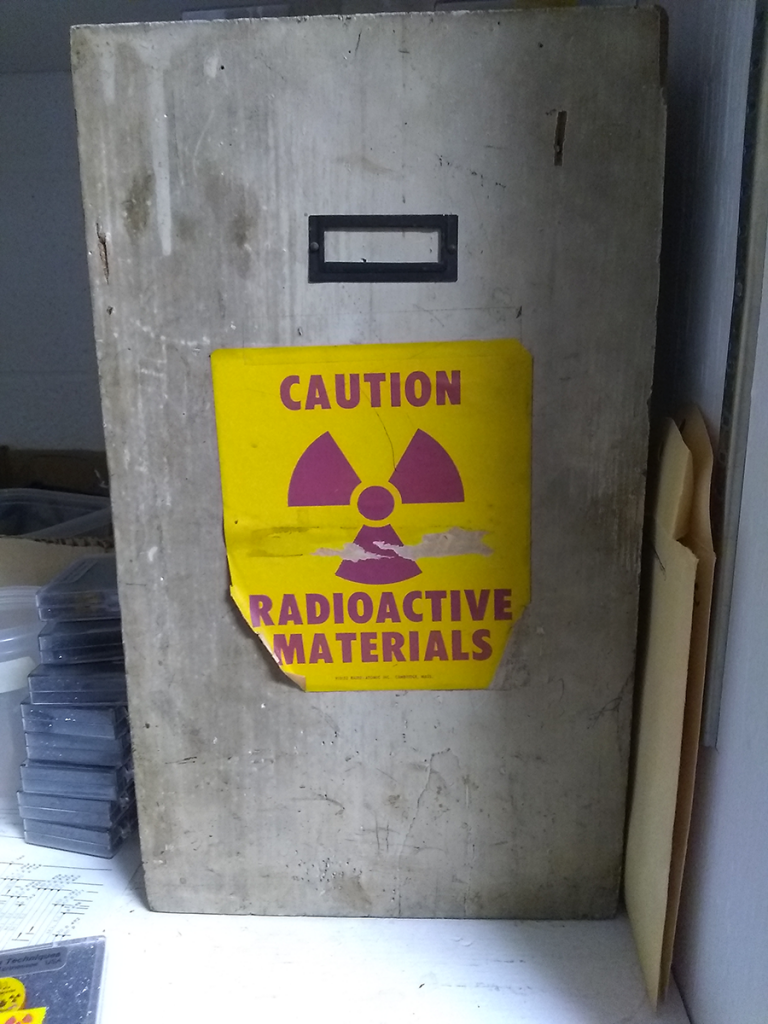
Big sticker!
We keep it way in the back of a locked storage room. It’s lined with lead on the inside, even if that’s not strictly necessary. You probably shouldn’t stuff a bunch of cobalt disks in your pocket for the day, and you definitely shouldn’t eat any. (Physics labs don’t typically use edible materials, and even when we do – such as non-dairy coffee creamer – we mark them as not for consumption. Just don’t eat anything in the lab, okay?) It does keep everything in one easy-to-find place, though, and big CAUTION stickers tend to keep curious fingers out.
We use big, scary yellow CAUTION signs in the shop to keep curious fingers away from sharp objects, too. Sharp and poky things are way more likely to ruin your day around here. So be careful, please.