Foot Candle Meter

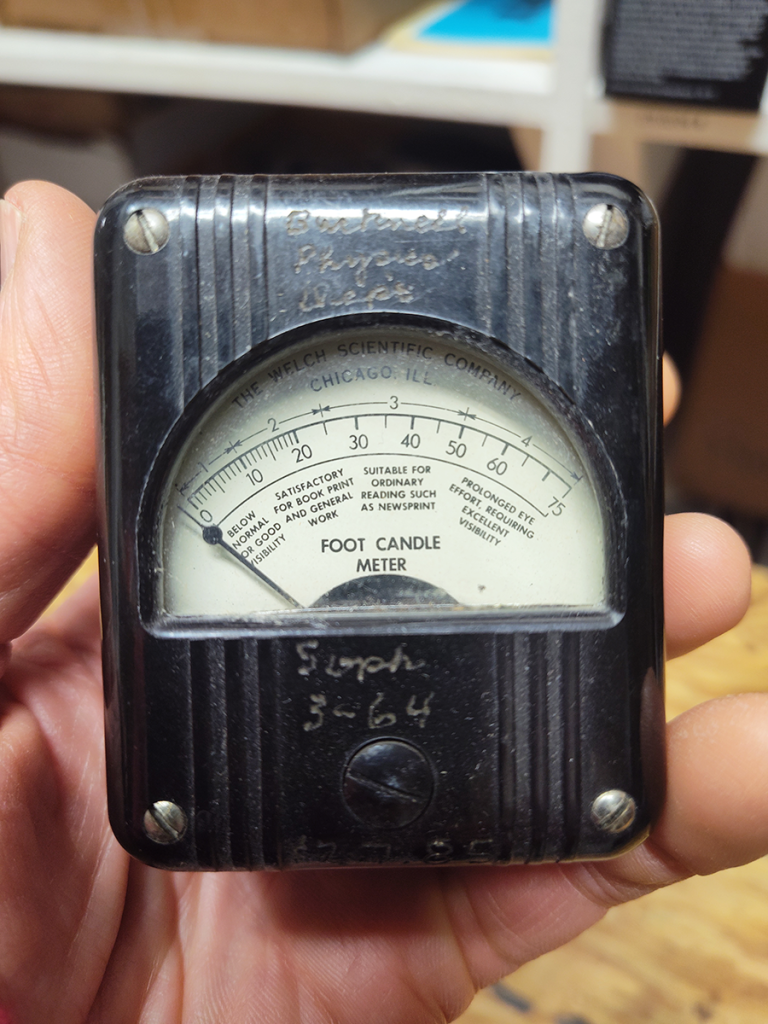
Foot candle meter, circa 1964
Yes, a footcandle is an actual unit of measurement.

Sometimes you stumble across little gems, squirreled away in the back closets, like these illuminance meters, acquired in March of 1964. Sadly, no cost etched into the side. Eventually, these were replaced with more modern versions, before being phased out of labs entirely.

We can guess how they were used – being next to a box of slide frames with a rainbow of color filters – and assume they’re not making a comeback. But check out all of that tiny, mid-century text crammed on there!

  • “Below normal for good visibility”
  • “Satisfactory for book print and general work”
  • “Suitable for ordinary reading such as newsprint”
  • “Prolonged eye effort, requiring excellent visibility”

Especially intrigued at the specific note about newsprint requiring twice the incident light of other reading, writing, and general tasks.

Classroom Key

Key with handwritten label: Classroom door key
Just one in the pile.

“Classroom door key.” Matter-of-fact, handwritten on a torn adhesive label. No need for building or specific room number identification. (The other side has no markings.)

Maybe there was only one classroom at the time? Maybe they were all keyed identically? Maybe the original bearer was only concerned with one specific classroom, one which needed no elaboration? Who knows?

Alligator Clip

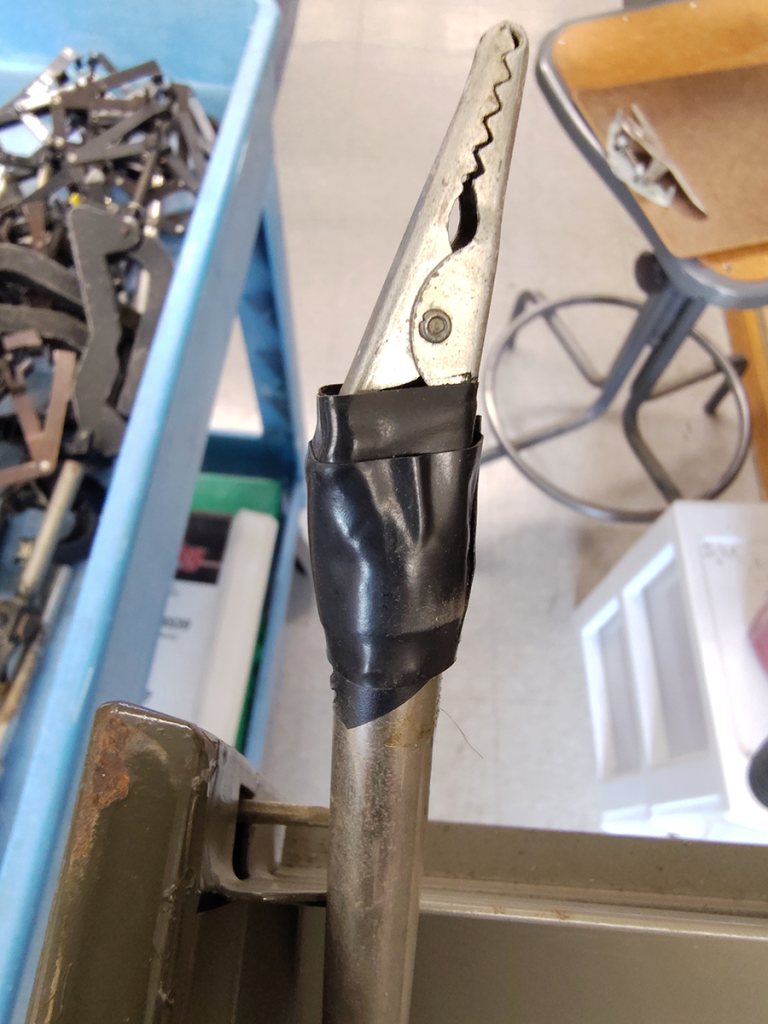
An alligator clip taped to a steel rod.
Fierce fellow!

Sometimes you stumble across a delightful artifact. One with an unknown, perhaps unknowable history. Clearly, at one point, it was necessary to hold an object in a particular place, and none of the available clips, clamps, or clasps were up to the task.

A steel rod, an alligator clip, and some electrical tape to the rescue!

What’s fascinating about this isn’t the specifics of the object, but the way that these temporary, stopgap solutions can linger. After enough time and use, they become ordinary and unremarkable. Familiar.

Until, some indefinite period of years later, a fresh set of eyes spots them in an old drawer. Look at what’s in here!
Blue Dot

Use blue dots for sure shots!

These are not flashbulbs, merely incandescent A-lamps, but check out the sweet vintage ad!

So the “blue dot” thing was a quality indicator that Sylvania used in their classic flashbulbs. A magnesium filament inside an oxygen environment within the bulb produced a bright flash of light, assuming the envelope hadn’t been compromised. A dot of anhydrous cobalt (II) chloride inside that zero-moisture bulb would remain blue. If there was a leak, atmospheric moisture would react with the cobalt chloride to turn it pink, an indicator that this bulb might not work.

What’s less clear is how, exactly, one wee flashbulb is going to effectively illuminate that whale – flash photography being not super effective at distance – but whatever.

Stamped

Lead brick, painted yellow, stamped by Nuclear Associates of Carle Place, NY.
It’s big, heavy, and boldly colored.

Lead bricks are useful things. This one – still bearing the stamp of Nuclear Associates, of Carle Place, NY – has had its fair share of scuffs and dents. (Lead’s soft stuff, you know.) These days it functions as a handy doorstop and a hands-on tool for explaining the density of matter.

Denser than water, than aluminum, than a nickel-iron meteorite. (All easy samples to acquire for demonstration.) Less dense than osmium; about half as much. (Not on hand, unfortunately.) Definitely less dense than the core of our Sun, by an order of magnitude-plus.

Also no handy samples of stellar core plasma on hand.

Do Not Touch

Orange warning label reads "CAUTION Touching or handling delicate optical components will destroy them"
If they could have added a klaxon, they would have.

There are times when you want your warnings to be relatively subtle. Visible, readily noted by anyone paying attention. And then there are the ones demanding you take notice.

Do you know what’s in here? (Not specifically.) Do you think you should open and check. (Not particularly.) Are you curious? (Yes, very much so.)

When there’s an obnoxiously bright orange label warning that fingers will destroy the contents, it’s easy to recall that there are loads of other toys around here which are a wee bit less delicate.

Yo-yos also come in bright orange.

Slide Rule

Large demonstration slide rule
Larger than is typical.

At one point in time, the slide rule was an essential tool in a physics/math/engineering education. Built and etched with high precision, they enable a skilled user to perform all sorts of mathematical operations with speed and ease. It’s the power of logarithms in a hand-held device.

Which, if you’re the sort of person who can master a slide rule, means you can also fully grasp the particulars of how one works.

It’s a smidge harder to get there with an everyday calculator. The gulf between the solid-state electronics inside one and the button-pressing interface is enormous.

Large demonstration slide rule
Concrete blocks: 16″ long.

At one point in time, this beast was a handy demonstration device at the front of the lecture hall. Visible from way in the back, it lets an instructor illustrate proper slide rule use to an entire class at once.

Not that that happens much anymore, but this thing is awesome. If you found one back in the closet, you’d keep it handy, too.