Keys

Coffee can full of old keys.
Keys to locks which no longer exist.

Another coffee can, this one half-filled with old keys, most unlabeled, almost certainly all of them to locks long gone. Not like “bucket of keys” is a prime organizational strategy, so one supposes these can be used for some exciting new arts and crafts project?

Handwritten key tag reads "Breathing Apparatus Cabinets 2nd Floor"
Are those still important?

Apparently, at some indeterminate point in time, the second floor held cabinets with a breathing apparatus inside. Respirators? SCBA systems like firefighters use? SCUBA systems like divers use? Pretty confident that those’re long gone.

Handwritten tag reads "etc."
Seriously?

This one has become disconnected from its key, so your guess is as good as ours. What useful information could that possibly offer? Like, even if we knew which key it identified?

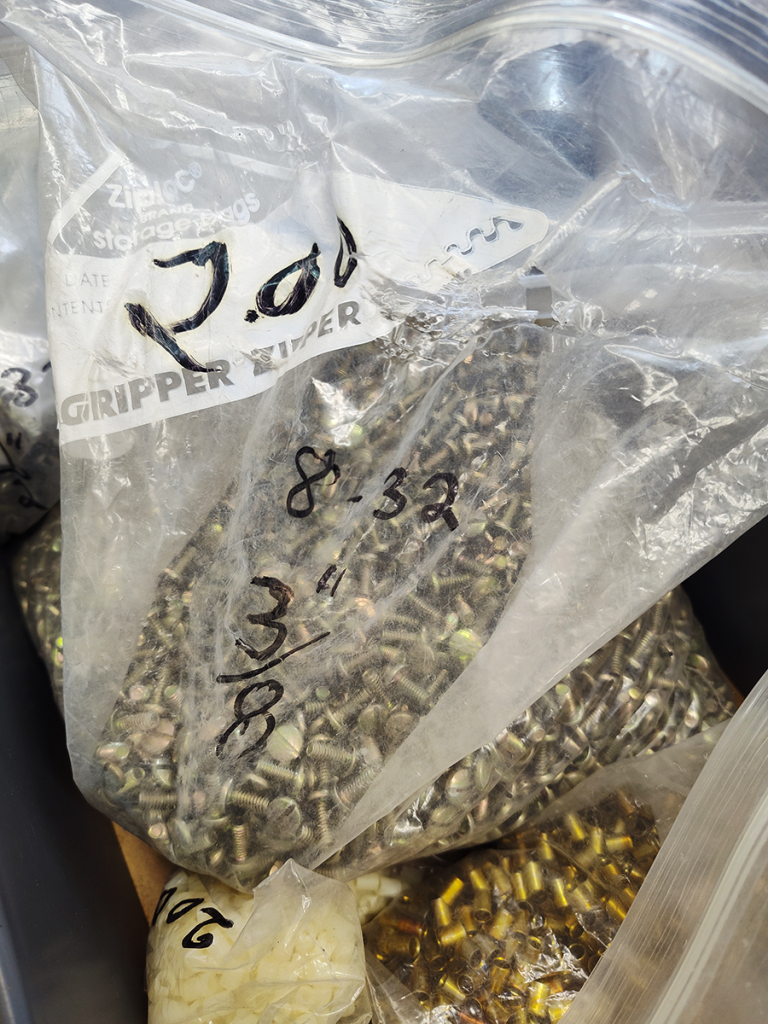
Can of Screws

Coffee can full of tiny screws.
In case you were wondering: it’s heavy.

It’s an old coffee can full of tiny screws. The ones on top appear to be #3-56 (fine thread) in stainless steel, though the variety beneath is diverse. All in all, weighing in at approximately 3,063g. Individual screws weigh in – from a coarse sample – between 0.11g and 0.67g each.

Not going to throw them out, but just as unlikely to know when they might ever be put to use. Or how, precisely, we’d expect to find the necessary screws buried in such a mass.

Just, please, don’t drop it on the floor.

Iterations

Lens holders and a series of 3D-printed parts, each very slightly different.
Getting there.

One of the key benefits of a 3D printer is the ability to create prototypes rapidly. Doesn’t quite fit? Adjust the model, re-slice, and set the new print to go. When you’re down to sub-millimeter tweaks with each iteration, it’s a relief to let the machine whir and ooze out the next version.

If at first you don’t succeed, try again and again and again and again…