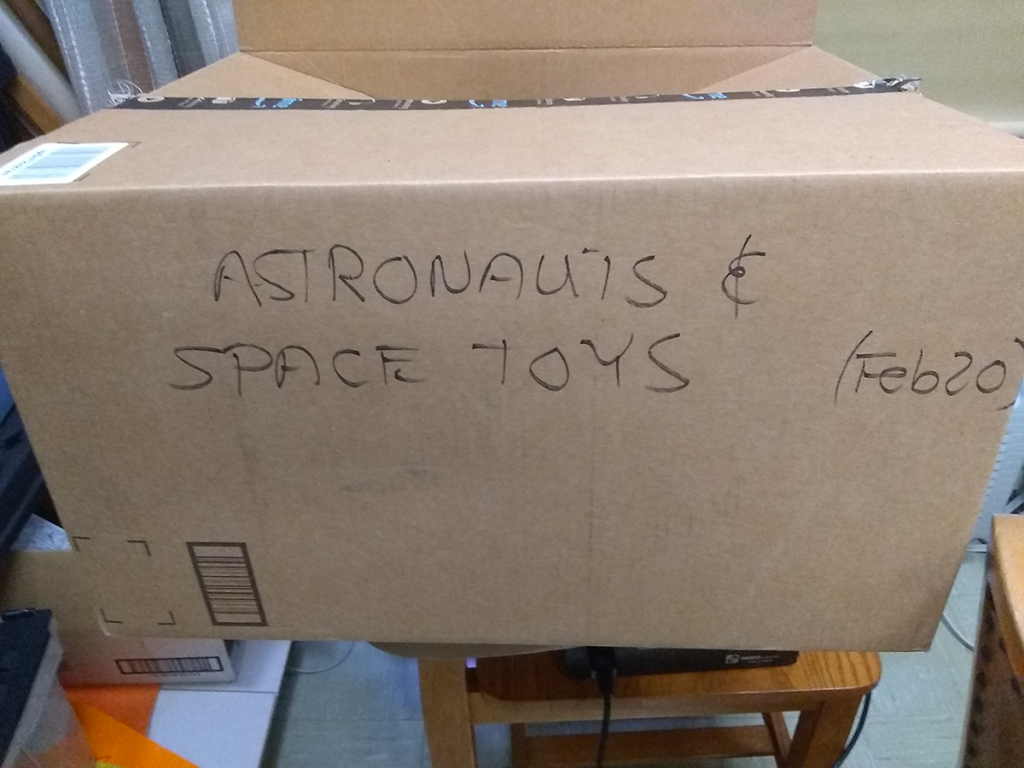
Some storage containers simply have more entertaining labels than others. Case in point: the cardboard box labeled “Astronauts & Space Toys,” which is neither large nor sturdy enough to contain a real astronaut, let alone several.
A find like this is just begging for exploration. We refer to a lot of things around here as “toys,” but these are the real deal.
Astronaut pieces.
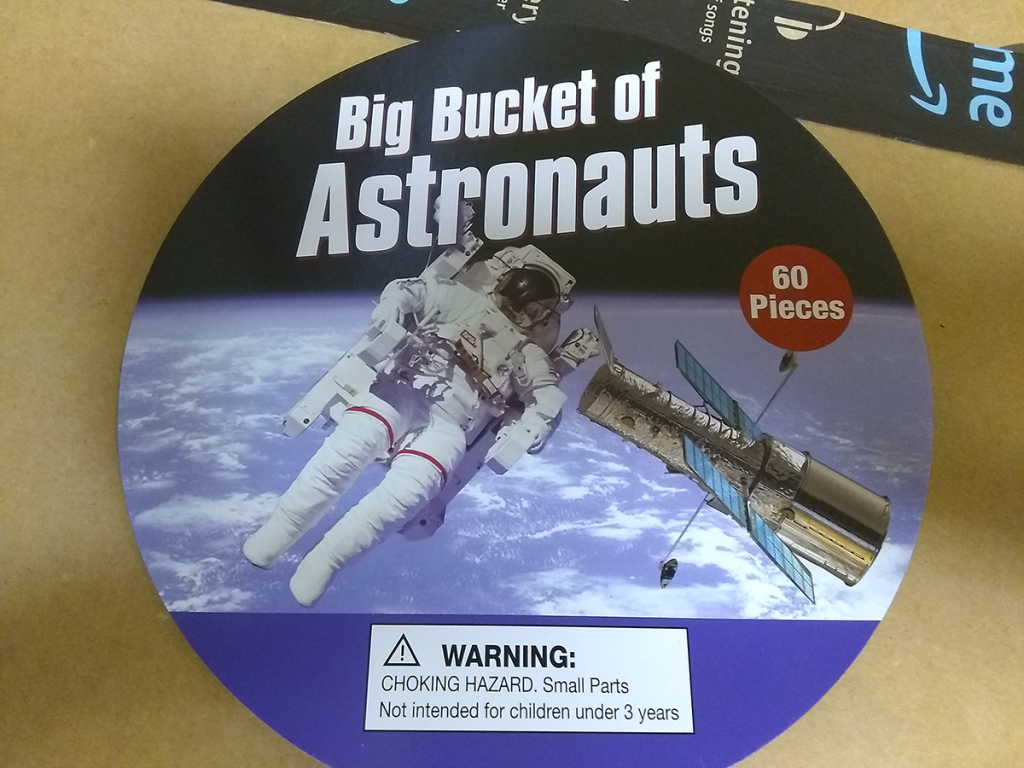
There are buckets – buckets! – of astronauts inside! Or possibly pieces of astronauts. It’s unclear.
There is a choking hazard warning. One can reasonably assume that choking hazards in space are worse than here on Earth.
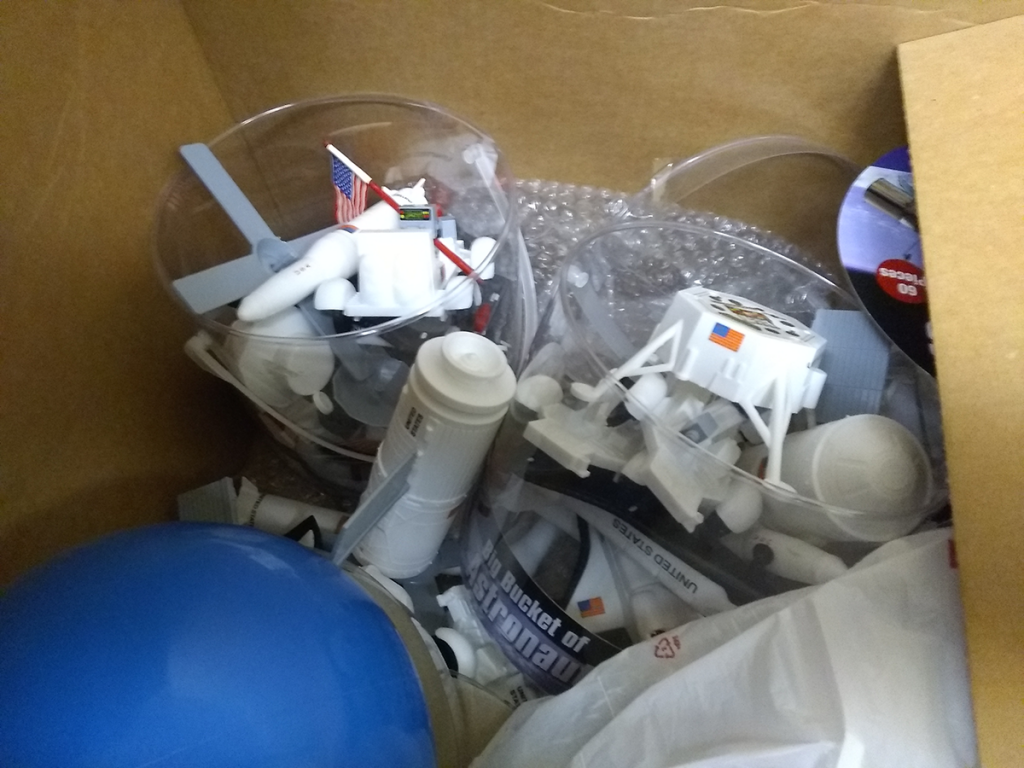
Buckets upon buckets.
The jackpot: toys! Fewer astronauts than advertised, but a substantially higher proportion of Lunar Module Eagles and Hubble Space Telescopes than expected. (Always entertaining to write those as plurals.) Chalk it up in the win column.
If this is how you convince the next generation that astronomy is cool, sign us up.
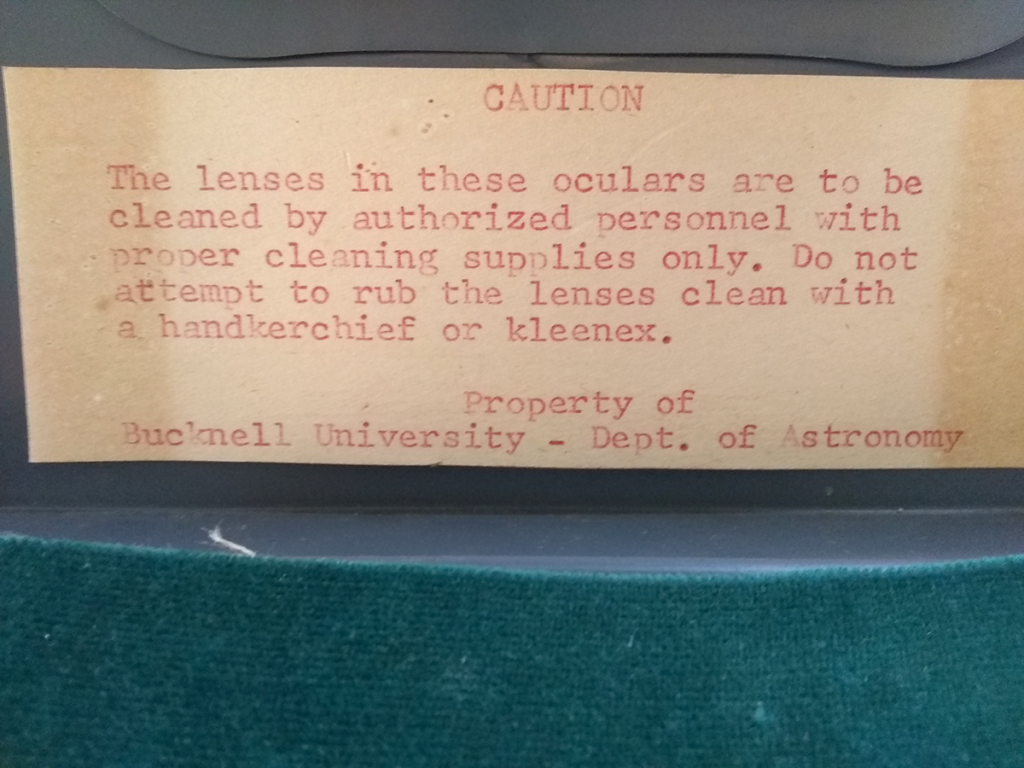
Do not attempt to clean expensive optical equipment with the same things you use to clean your nose.
Remember: instructions that seem to lay out the most common-sense directives – on signage, in user manuals, in a specification document – are sometimes the result of people actually doing those questionable things.
You can bet someone tried cleaning a telescope’s eyepiece with the handkerchief from their pocket.
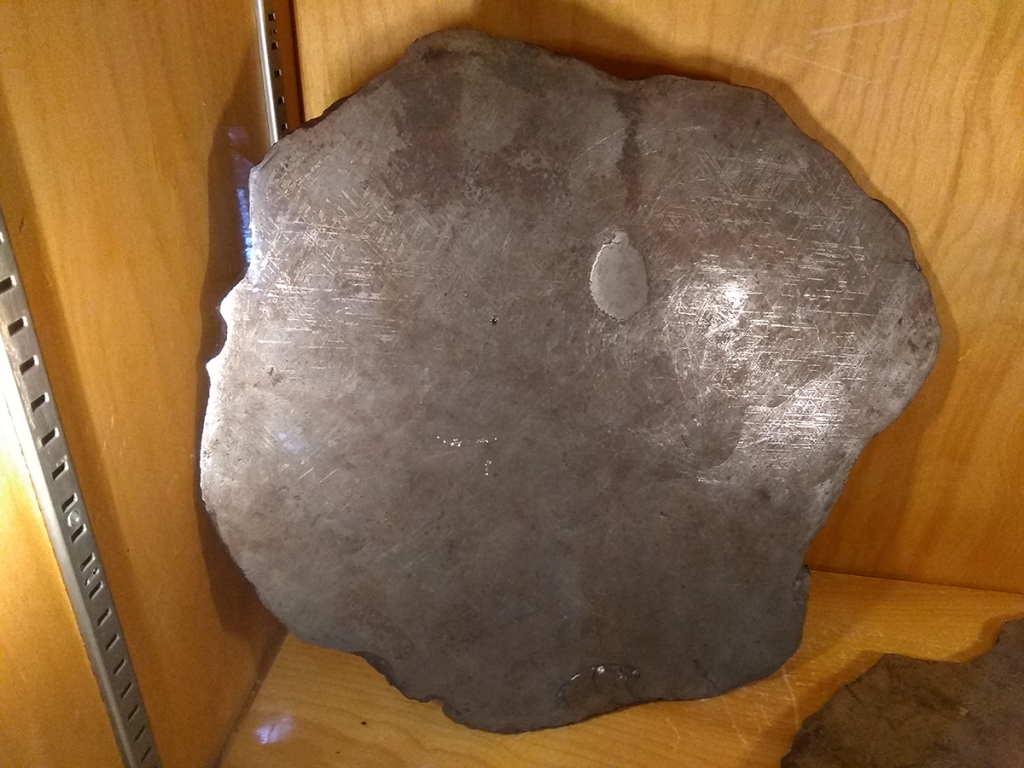
Meteorites – those shooting stars which don’t completely burn up entering our atmosphere and then crash to the ground – can be made of all sorts of stuff. The most commonly found in museums and collections are metallic, not because they’re the most frequent type of meteorite, but because they’re the most likely both to survive entry/impact and to be discovered. A stony meteorite might look remarkably like an ordinary rock. A big chunk of warped iron just sitting on the ground? Slightly more conspicuous.
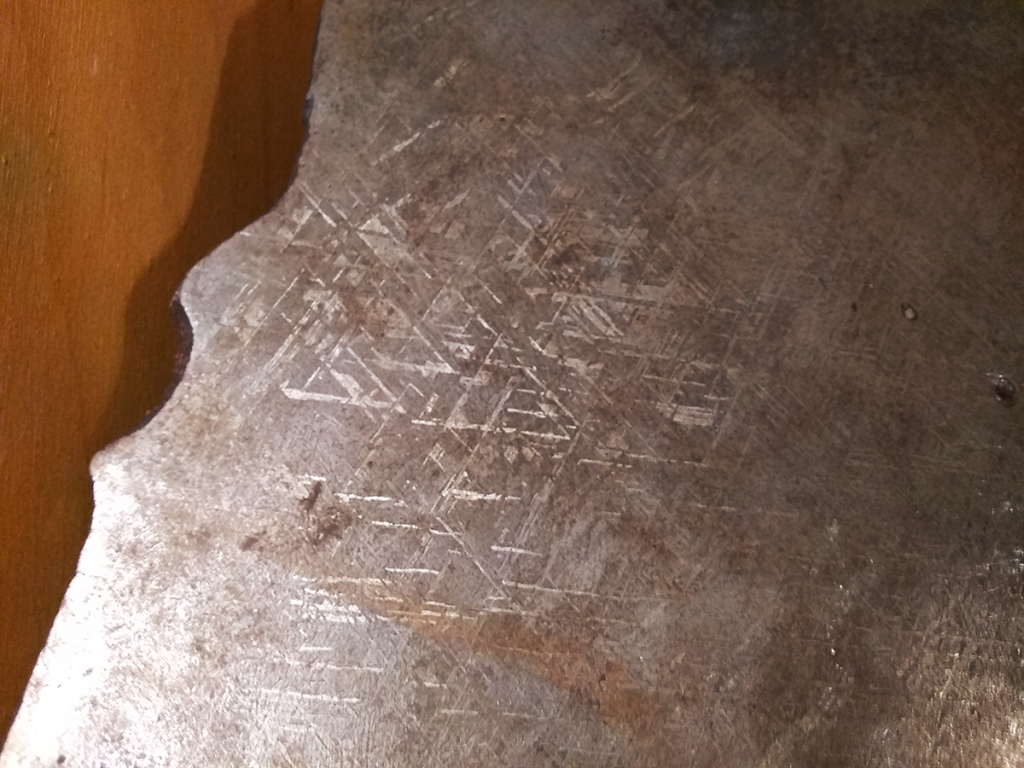
We have a few meteorites and pieces of meteorites on display, including this big slab. Cut, polished, and given an acid treatment, it shows off its internal crystalline structure. Primarily iron and nickel in two different crystalline shapes, it has a characteristic pattern known as a Widmanstätten pattern. Given a sufficiently long cooling period to enable crystal formation – typically on the order of millions of years – it produces this distinct appearance that highlights its extraterrestrial provenance.
Can’t do this stuff in a lab is what we’re saying.
The acid-etching process enhances the pattern where the high-nickel taenite alloy is more resistant to the acid than the low-nickel kamacite, turning a smooth, polished surface into one that looks, well, really cool.
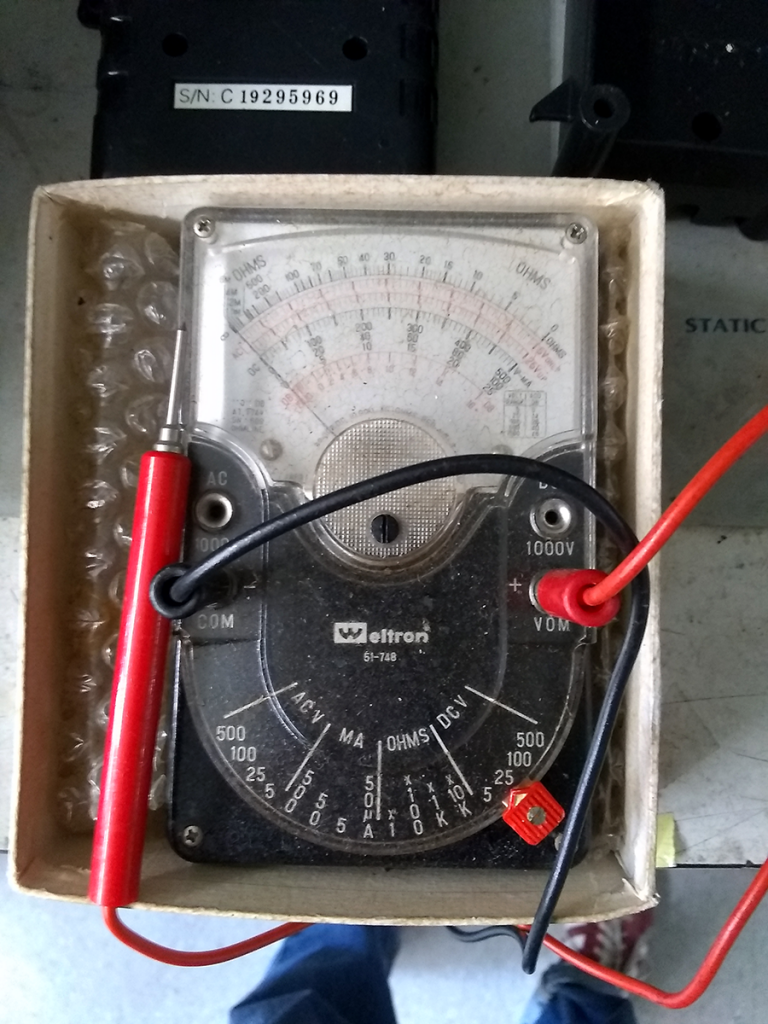
Stumbled across this little old gem while cleaning the Observatory. Age unknown, could use a little cleaning, but it still mostly works. We’re charmed by all manner of objects around here.
A great many jobs in the daily work of a shop consist of riffs on this: can you make item A connect to item B? It might be physical connections, electronic and/or digital signals, or even the relatively abstract interpretation of transitioning a lab space over from one experiment to the next without disruption. The simplest ones are when someone can’t locate the proper connector cable. (There are so many different kinds!) Less simple are those times when two things are supposed to fit, but don’t.
Just straight-up don’t.
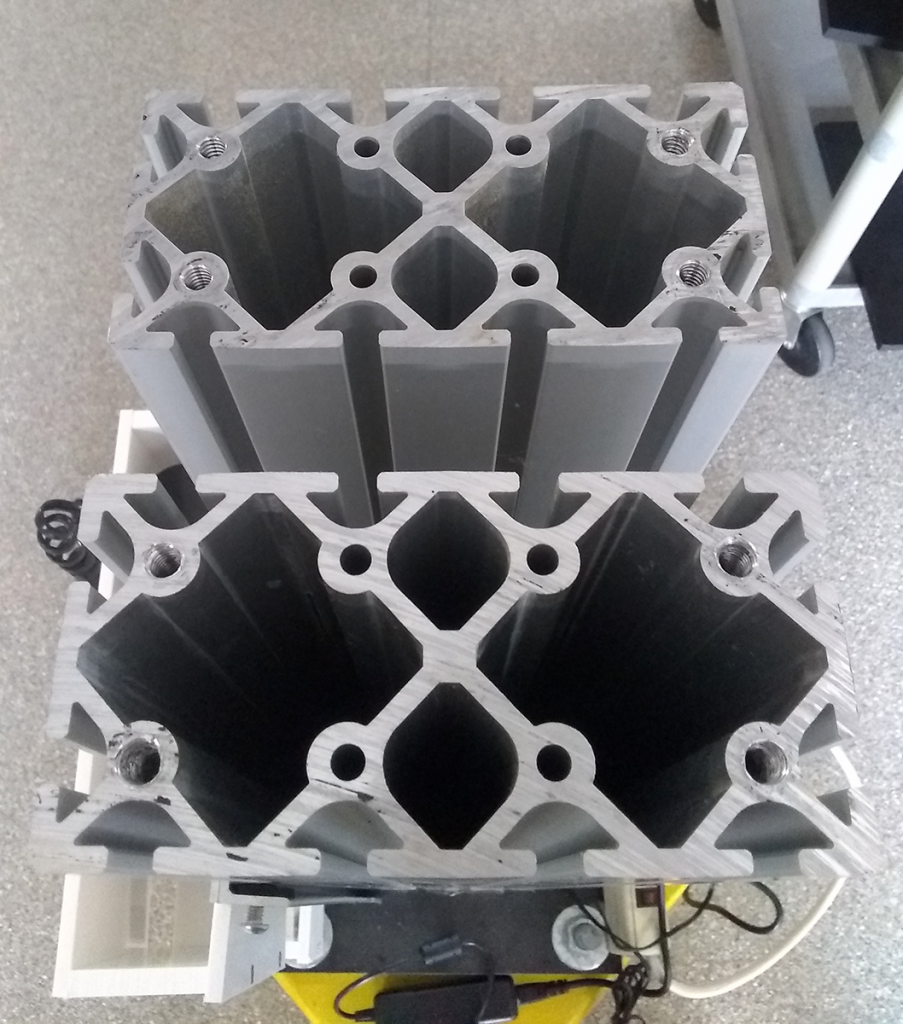
At the Tressler lab, we have the luxury of permanently-installed piers which support our telescope mounts. For our purposes, this is an excellent improvement over the default, a very stable yet heavy tripod. Now in the process of upgrading our mounts, we find that the tapped mounting holes on the pier don’t match the drilled and counterbored corresponding holes on the custom-made mount adapters. By 1/8″ or more in some cases. Sounds small. Is actually huge. Is will-not-fit-even-with-brute-force huge.
Note: not made in-house. We could try to guess where the error might have arisen, but our job is to fix it.
Also note: the previous mounting plate was not precisely machined to the proper dimensions, either, but was close enough that it was fastened by brute force. Sensing a theme here, which is this: precise measurements are crazy hard.
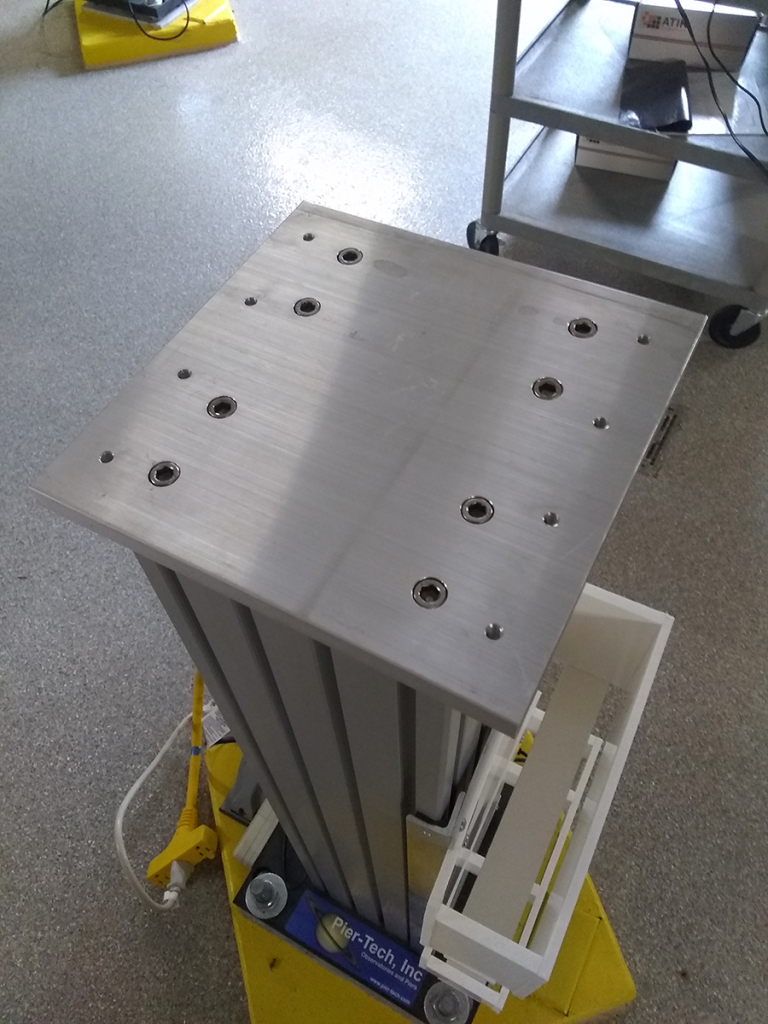
Fix holes with more holes.
Getting to the adapter-for-the-adapter called for more than one CNC-milled plastic prototype. Measure, mill, test. Rinse, repeat. Polyethylene, as one might imagine, is cheap stuff.
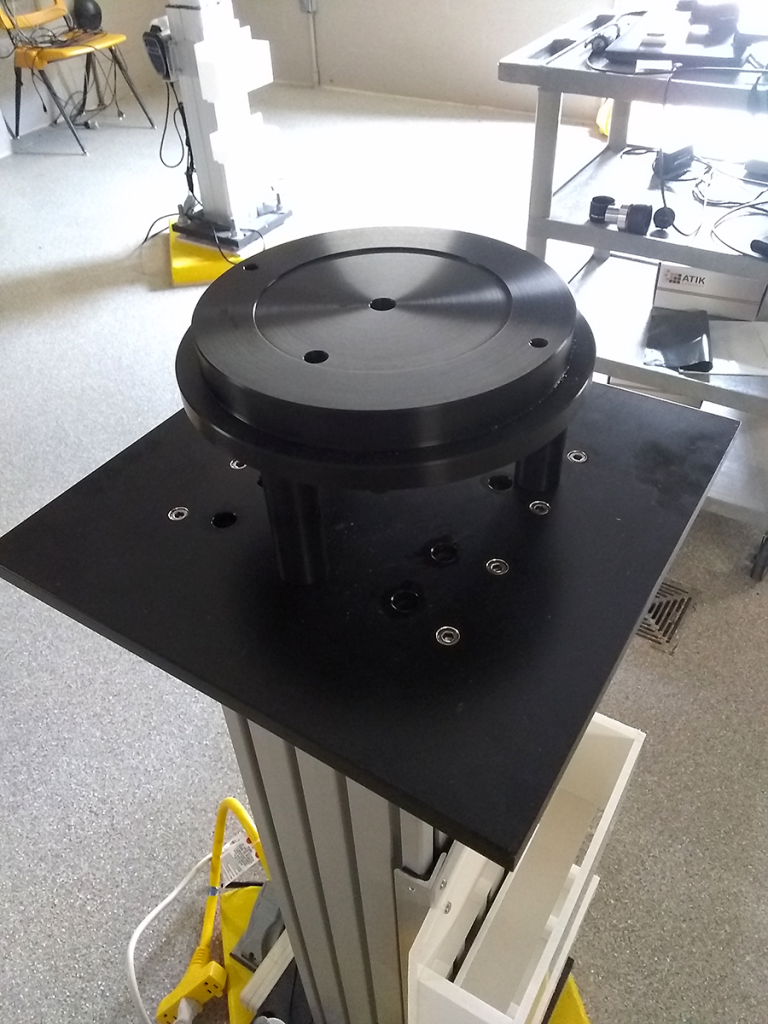
A few test runs later, we have a custom-machined (in-house!) sheet of 1/2″ aluminum to connect to the 5/16″-18 tapped holes on the pier, which then sets up a new series of 1/4″-20 holes in this plate and the mount adapter to hold everything rock solid. Holes drilled and tapped, counterbored for a clean surface with all of those socket screws.
And all carefully measured and aligned on the milling machine to within 0.001″.
No one notices the unused holes in the dark.
You don’t appreciate the precision of reliable machinery and sharp tooling until the pieces slip together effortlessly. Whoa! Goosebumps!
Best part? The adapter is functionally invisible for anyone who doesn’t know to look for it. Few things feel as rewarding as solving a problem before (almost) anyone else realizes it’s there.
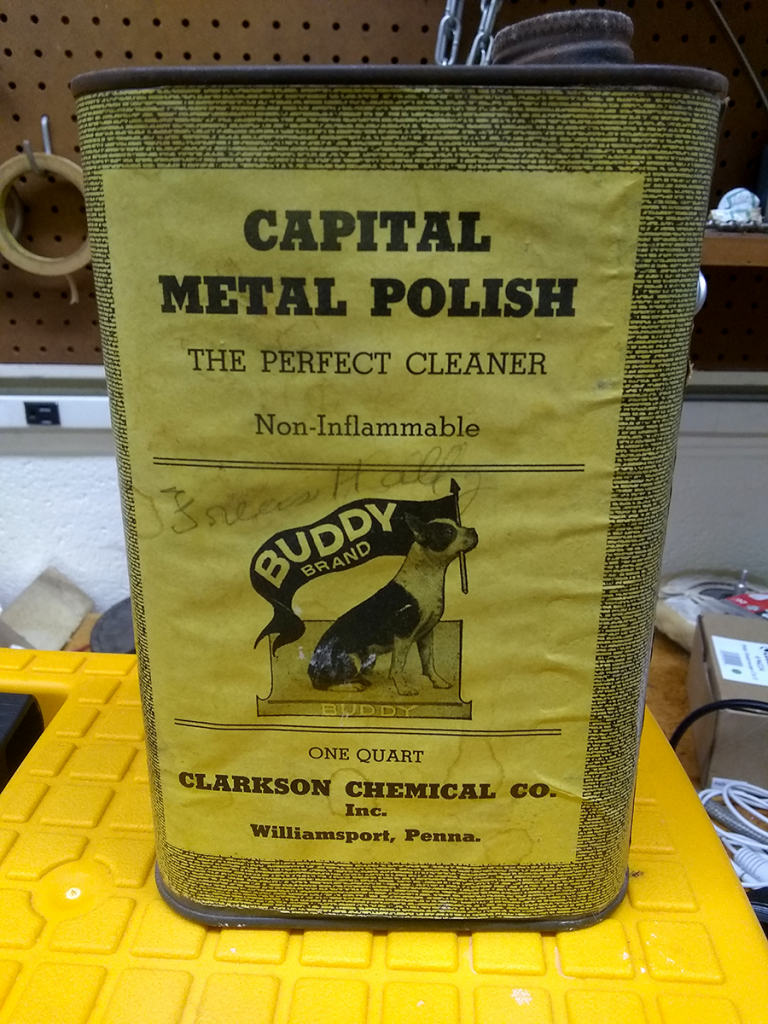
Sometimes, stuff just lingers. It’s unclear how long it’s been sitting on this or any shelf, whether it has any use anymore, how on earth to dispose of it, etc. Of course, those odd objects tend to sport some of the coolest old labels.
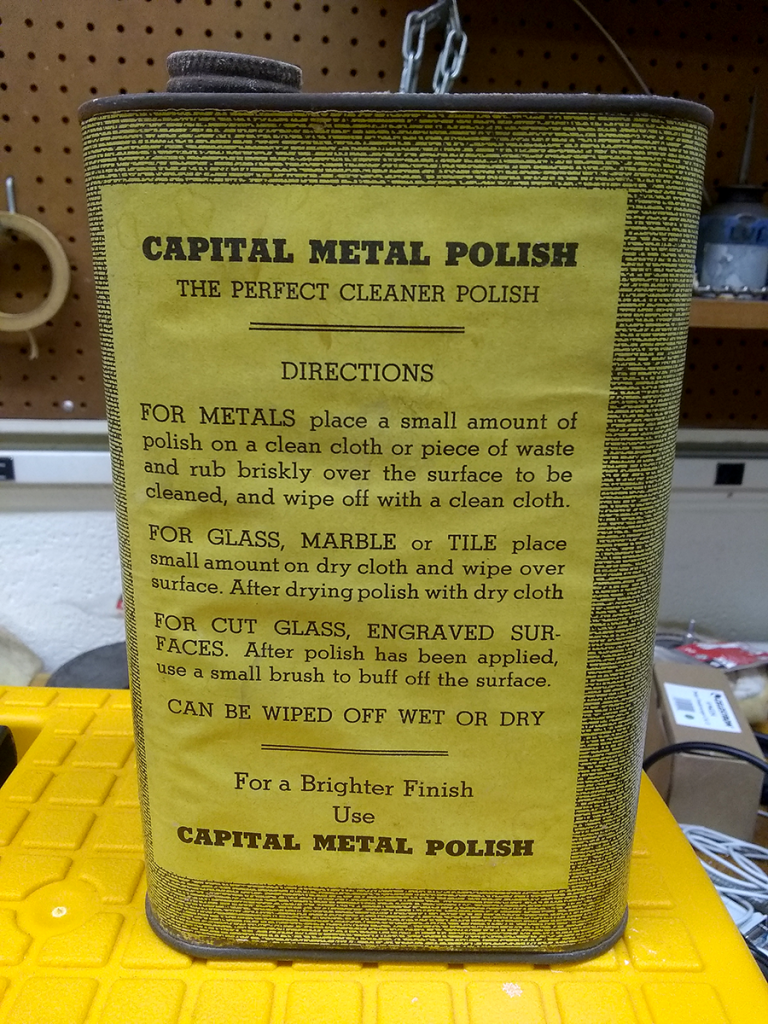
So much to enjoy here! Buddy the dog, holding a flag with his name, but also helpfully labeled below as “Buddy,” just in case it wasn’t obvious enough. Directions for using metal polish on non-metallic surfaces, which – to be fair – might not be obvious. (Still mostly amounts to wipe on with a soft cloth, wipe off with a soft cloth.) The prime visual real estate for “Non-Inflammable,” which is an entertaining reminder of the flammable/inflammable quirk of the English language. What a country!
It’s not entirely clear if the yellow color was an original choice or has been caused by many years of aging paper.
Seems pretty straightforward.
At any rate, the steel cap is thoroughly corroded shut, so there’s no telling what remains inside. Whether that corrosion is caused by or despite the contents of the Capital Metal Polish container, we’ll never know.
Yes, this telescope can rotate all the way around.
Telescopes don’t work when they’re not at the same temperature as the surrounding air. They don’t work if there is glass between them and the sky. (Okay, they work, just not very well.) So: you use them outside, and any space used to protect them from the elements is best if it’s as much like outside as possible.
Observatory domes, retractable roofs, etc.: all very fancy ways to keep the rain off.
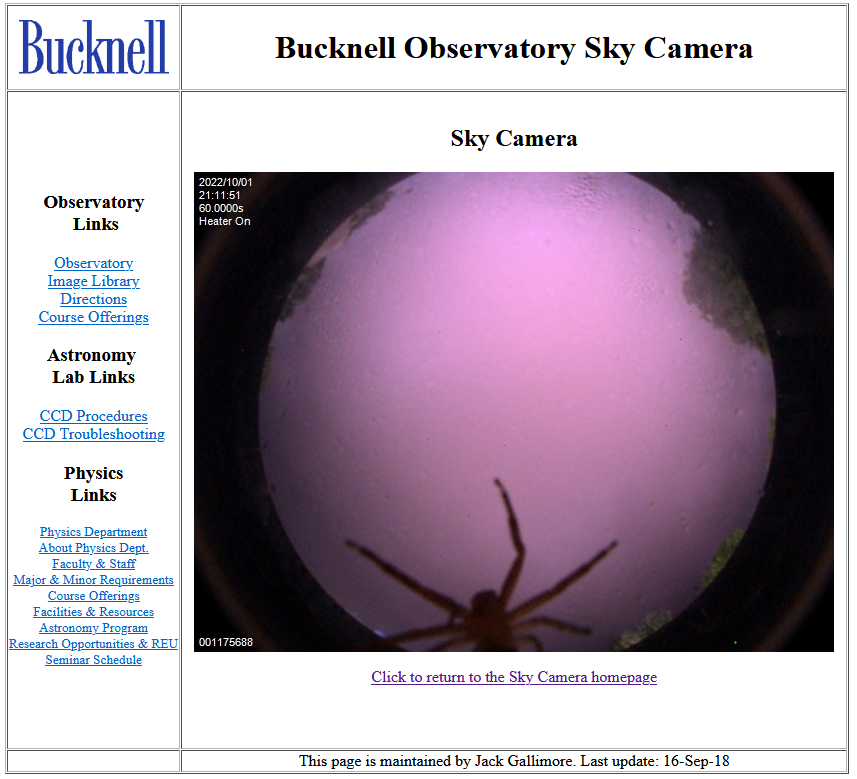
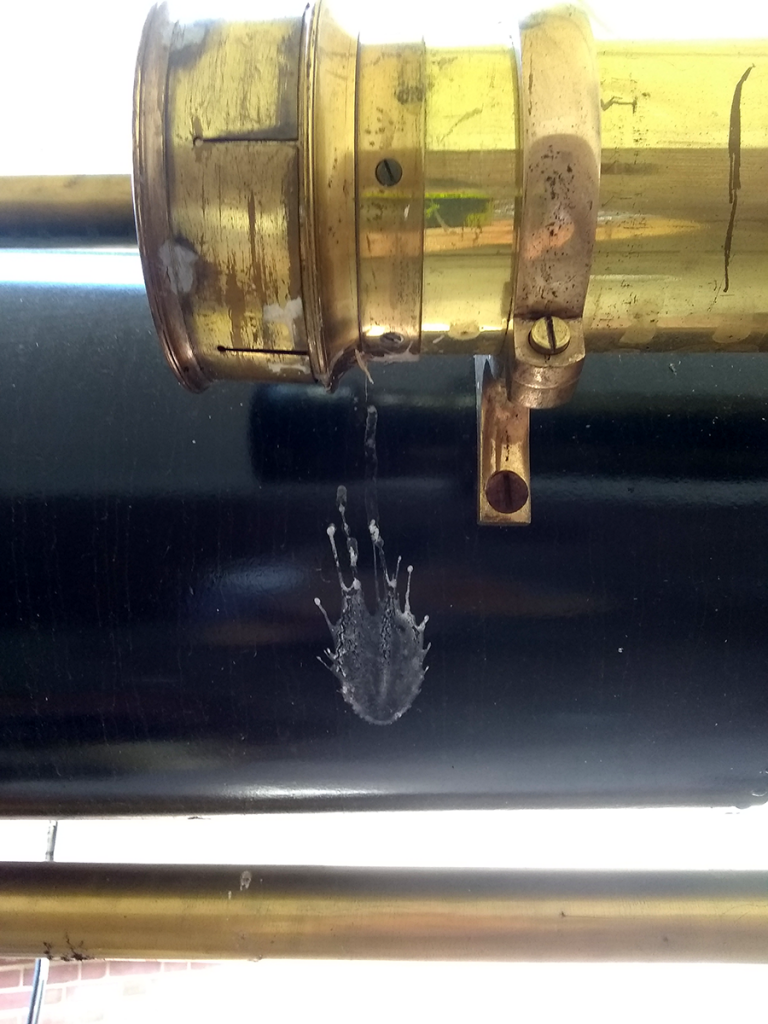
Wildlife has a habit of getting into these spaces, especially the small critters. Spiderwebs are a frequent feature. Birds appreciate the shelter from the elements, and will happily build nests if given sufficient access. It’s amazing what they’ll squeeze through, if for no other reason than to leave a stark white splotch on an all-black telescope. At least it seems that way.
This doesn’t include the exterior-only wildlife population that brightens up the occasional observation session. Nocturnal critters get used to the quiet around daytime spaces, so it’s best to keep alert for opossums and skunks and other adorable visitors when out late at night. That black-and-white blur is probably just a feral cat, but you know what? Best not find out for sure.