Repurposed Boxes

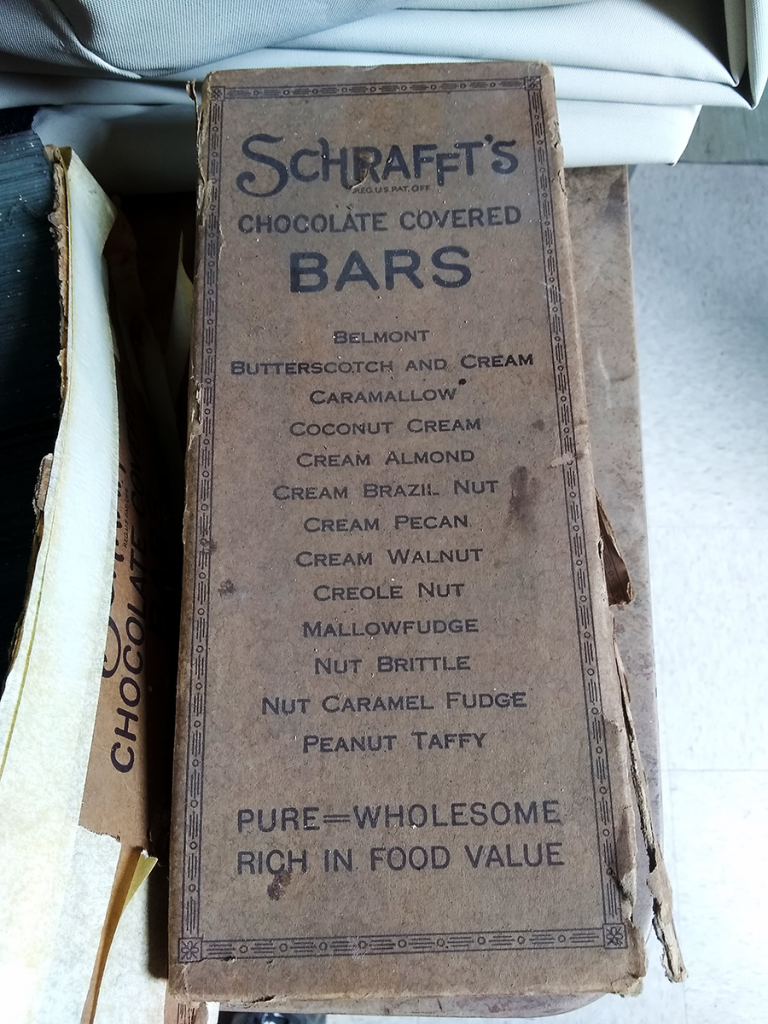
Schrafft's box, top
What’s “Belmont” flavor?

No one expects an antique box of chocolate bars – a Boston-based brand which went out of business in 1981 – to contain those candies anymore. We reuse boxes all the time, and the key factors are size and durability. D-cell battery boxes are in relatively high demand, for example; good size and sturdy. Chocolates boxes, it seems, were once just right for storing lots of glass plates. This was so long ago, though, that the original use has become somewhat obscure. (The glass plates. No one’s confused about the eventual fate of the chocolate bars.) Now the boxes are more intriguing than their contents.

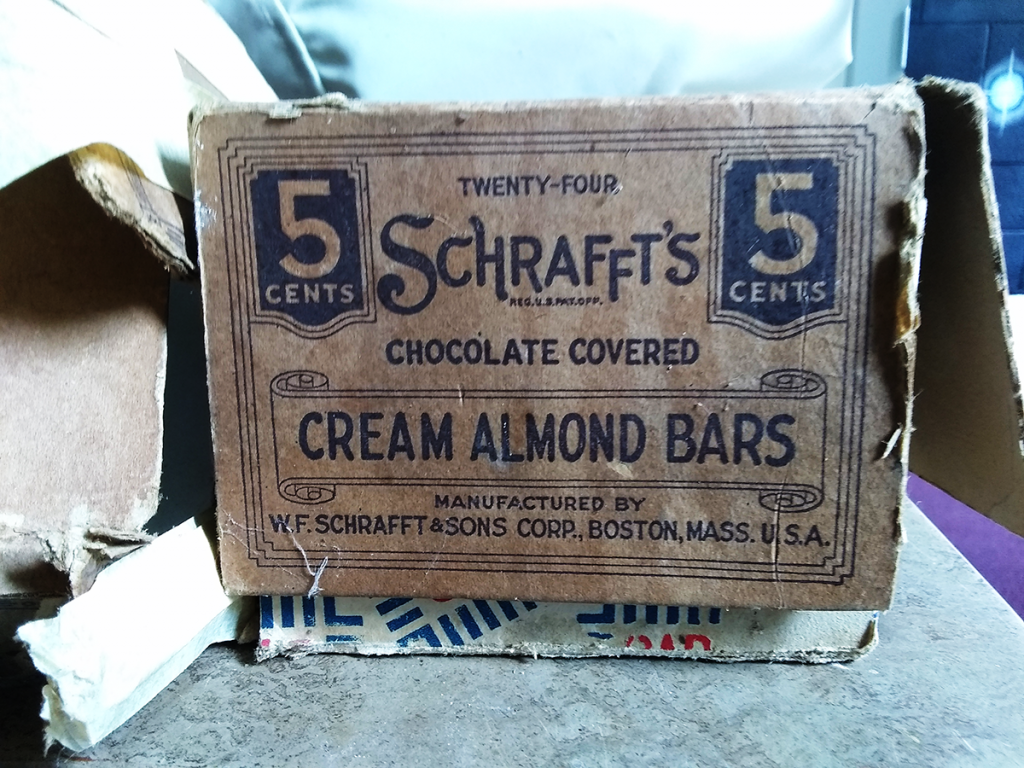
Schrafft's box, side
Five cents seems reasonable.

Idle thoughts bubble:

  1. What an interesting array of flavors! Belmont? Mallowfudge? Creole Nut? Presumably Caramallow is a caramel-marshmallow hybrid, whatever that meant in practice.
  2. Why is it Coconut Cream, but all of the others are ordered as Cream Almond or Cream Walnut? (Cream Brazil Nut?)
  3. “Pure = Wholesome” feels appropriately late-19th-century and kind of creepy.
  4. “Rich In Food Value” feels appropriately early-20th-century and definitely creepy. Or possibly written by ChatGPT; still creepy.

Mystery Resistors

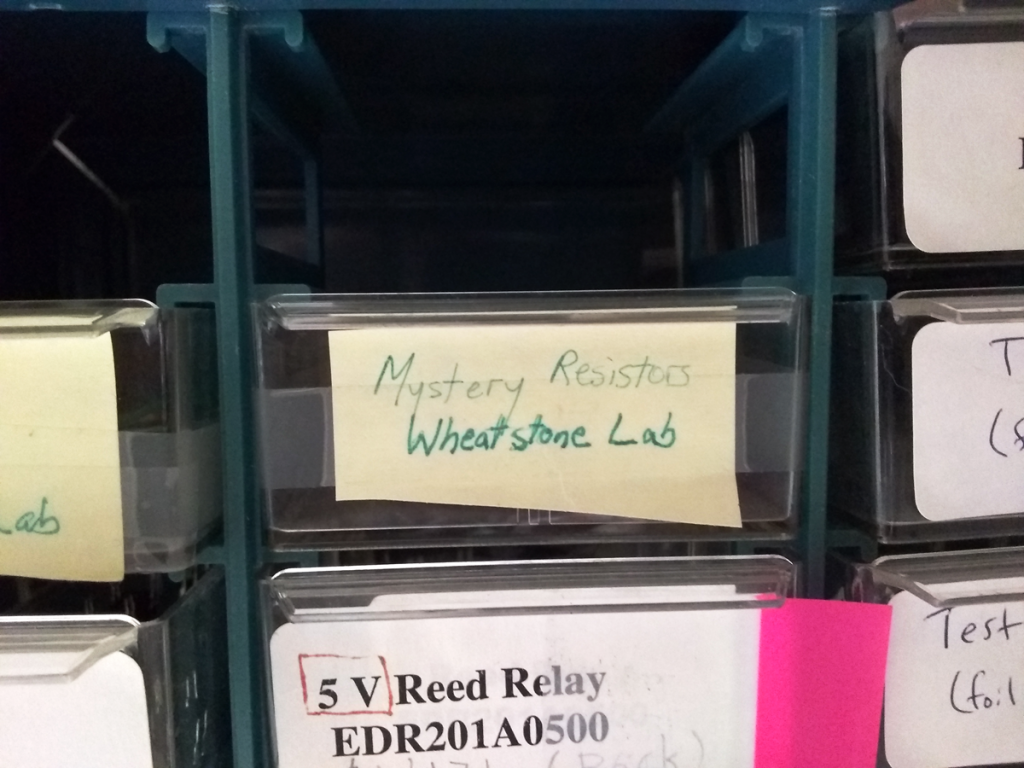
Mystery resistors label
*spoOoOoky*

One of the many entertaining quirks of an academic setting is the need to organize certain things to conceal their specific nature. When running student labs, it’s not uncommon to give them something to measure using the theory and techniques they’ve recently learned. The instructor knows the approximate Ohm value of the resistor, but the students need to construct a Wheatstone bridge and measure it, because we’ve cleverly concealed the color markings with tape, or permanent marker, or shrink-wrap tubing. Whatever it takes.

Then it goes into a little bin with an entertaining label like MYSTERY RESISTORS! and we get a bit of minor entertainment every time we walk by.

MYSTERY!

Old Electronics

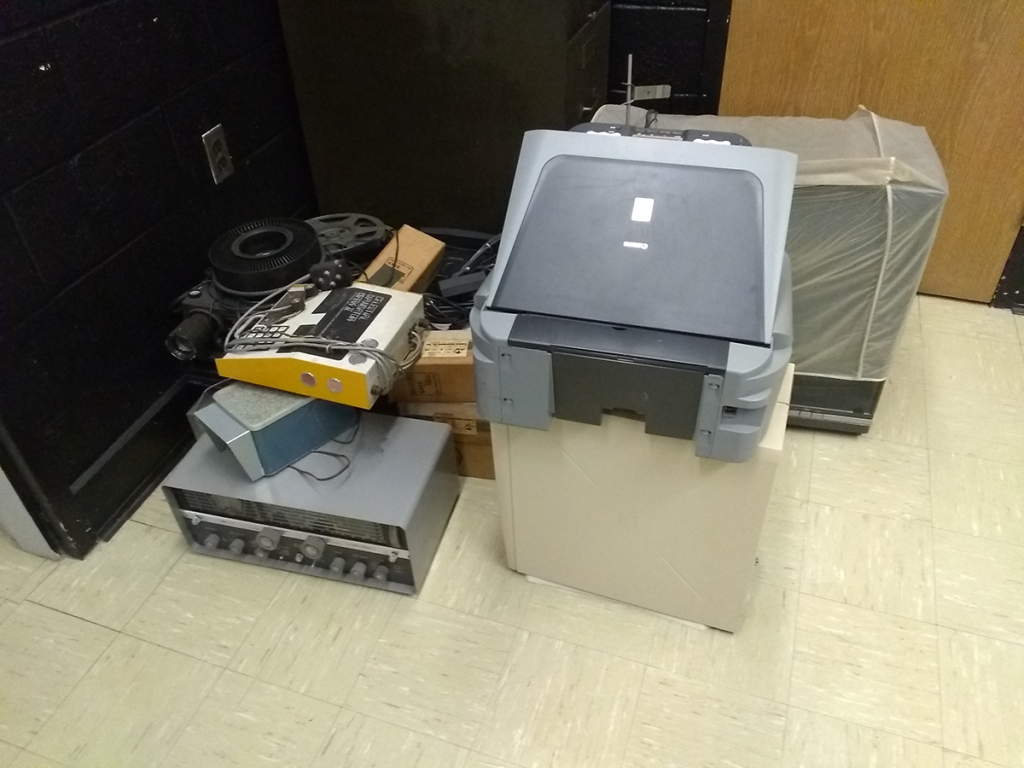
Old stuff, destined for the dump.
A pile of decrepit victory.

In the process of clearing space, you come across all manner of ancient and fascinating things. Desktop computers. Inkjet printers. CRT televisions. Slide projectors. Old motors and control gear to approximate sidereal motion.

Well, okay, reverse sidereal motion. The reason telescope mounts cost more than telescopes, because keeping stars and deep sky objects fixed in the field of view is no small task.

We’ll pop some of these open, gut ’em for any good parts, and move the remainder on to e-recycling. It’s the cycle of e-life!

Beats

wobblewobblewobble

In acoustics, there’s a phenomenon known as beats, which is when two similar tones generate an interference pattern that sounds like a pulsing beat. It happens with waves of all kinds, waves being moving energy and all that, but sometimes it’s easier to really get the sensation when you hear it. Graphing out the sinusoids and showing the constructive and destructive interference helps explain it. Hearing that wubwubwubwubwub cements it.

We have what looks, at first glance, like a glockenspiel, with its metal bars all in a row. Tap one with the mallet, and it sounds almost the same as the one next to it. Almost. Tap two at once, and you get the beats.

At one end, it’s 440 Hz. Then 439, 438, 437, 436, and 435 Hz. Not only can you hear the beats, but you can very clearly hear the change in beat frequency as you combine tones in different combinations. It’s very cool.

Also quite unnerving after a while. woobwoobwoobwoobwoob

Compass

Magnetic compass face.
North!

We have many, many compasses scattered about the department. The vast majority come and go as part of the toy kits for PHYS 212, tiny ones useful for illustrating the effects of magnetic fields. Probably more that than for wilderness orienteering. Note: a physics toy kit, despite its educational and entertainment value, is probably insufficient on its own for wilderness survival. Check with the fine folks at Outdoor Education & Leadership for that.

One of the entertaining compass demos is to array a circle of them around an unshielded wire, and seeing the effect of turning the current on and off. Half a dozen little red arrows snapping to attention never loses its neat-o quality.

There’s also this little gem, tucked away in one of our closets. Inscribed with a nice little dedication, reading “TO BUCKNEL / A FRIEND” on the side. Which, the longer you look at it, seems a little less clear each time.

Compass inscription.
Oh. Okay?

Maybe you had to be there? Interpret it as you will.

“The Perfect Cleaner”

Capital Metal Polish can.
Buddy Brand!

Sometimes, stuff just lingers. It’s unclear how long it’s been sitting on this or any shelf, whether it has any use anymore, how on earth to dispose of it, etc. Of course, those odd objects tend to sport some of the coolest old labels.

So much to enjoy here! Buddy the dog, holding a flag with his name, but also helpfully labeled below as “Buddy,” just in case it wasn’t obvious enough. Directions for using metal polish on non-metallic surfaces, which – to be fair – might not be obvious. (Still mostly amounts to wipe on with a soft cloth, wipe off with a soft cloth.) The prime visual real estate for “Non-Inflammable,” which is an entertaining reminder of the flammable/inflammable quirk of the English language. What a country!

It’s not entirely clear if the yellow color was an original choice or has been caused by many years of aging paper.

Capital Metal Polish can back.
Seems pretty straightforward.

At any rate, the steel cap is thoroughly corroded shut, so there’s no telling what remains inside. Whether that corrosion is caused by or despite the contents of the Capital Metal Polish container, we’ll never know.

“The Pit”

Bilco door.
Feed the pit.

When you have a regular need to open lots of doors – accessing equipment, supplying labs and classrooms, helping coworkers find their misplaced keys – the powers that be may be kind enough to cut you a master key. Saves time, effort, and several pounds of metal on a keyring. They are, of course, master keys with a limited range. Certain doors are off-limits.

The access door to the elevator-base maintenance? That’s a place we don’t need to be. It’s only important that we don’t stack anything of substance on top. (The roll of plastic seen here could be blown away by a light breeze.) Not that it wouldn’t be neat to have a look inside – after all, who wouldn’t like to check out some new kind of specialized machinery? – but if the elevator’s working, maybe let it be.

That said, it’s hard not to be fascinated by the accompanying light switch:

Pit light switch.
“Pit Light”

Sure. Of course. How else would you label it? Dark, forbidden basements should always get the proper horror movie styling.

And then there’s the nubbin of a switch. Makes one wonder. Can’t possibly be from overuse. (Can it?) Implies that someone did that on purpose.

Maybe the answer’s down in the pit.

Acquisition Dates

Optics rail acquisition 9/27/43, for $40.00
Most impressive is that the yellow paint has lasted this long.

It seems the university has drifted away from this, but if you look around at old equipment, a great deal of it is marked with the date it was acquired and – if it’s old enough – the cost. They’re fascinating glimpses into the past.

Here, an optics bench made by the Central Scientific Co. of Chicago, Illinois. Or, as they’d prefer, Cenco of Chicago, U.S.A. This particular 132cm chunk of cast iron and steel joined the department in late September of 1943, for the low, low price of $40. According to the U.S. Bureau of Labor Statistics’ CPI Inflation Calculator, that’s an excessively specific $681.17 in today’s dollars. (Significant digits!)

Cenco plate
Surely there’s a reason for the cities listed in that order.

Up until now, it’s been in more or less continuous lab use, only recently replaced by brand-new extruded aluminum optics benches. Almost 80 years, and they’re not entirely kaput just yet.

After all, if an apparatus continues to be useful, we’ll keep it around. This one is getting repurposed for future labs, so we’ll see how many more decades it has in it…