When a faculty member retires, they tend to leave a variety of things behind in their labs. With the busiest days of physics research behind them, and only so much spare garage and attic space, old pieces of scientific apparatus don’t make the cut. That doesn’t mean they’re not useful to someone else. Sometimes old equipment, built for a long service lifetime, still works pretty well. Those few things built without integrated circuit boards and lacking in bells and whistles? They’re tanks. We collect those, make sure they’re in good working order, and keep them handy for the next person who needs them.
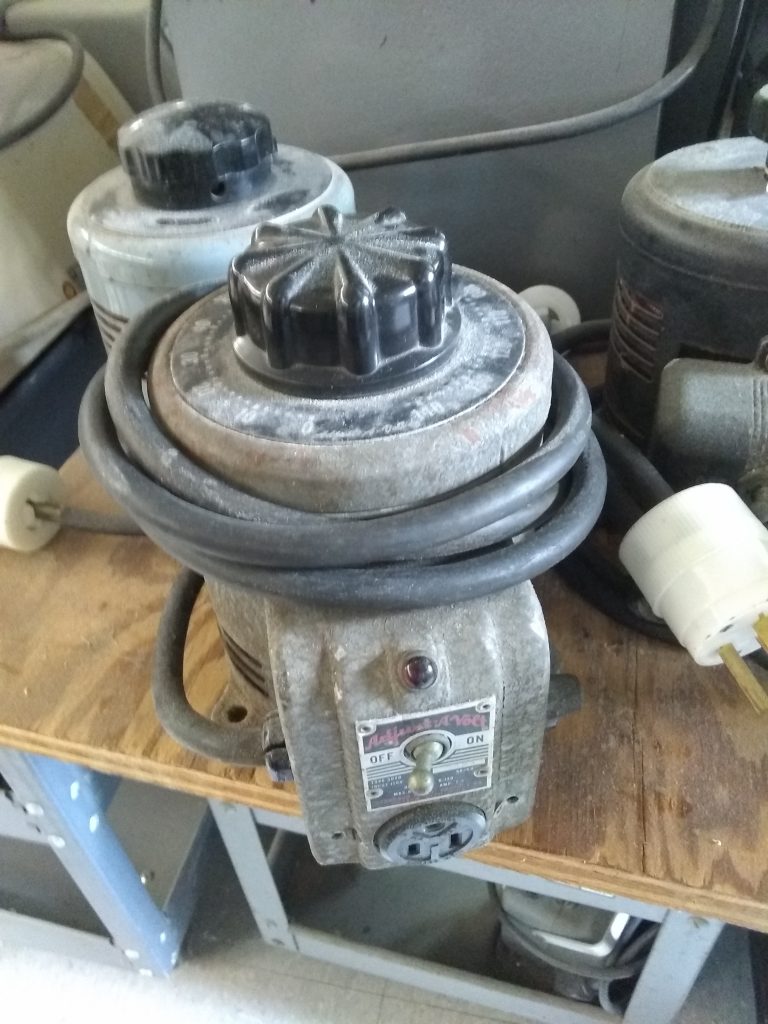
Take, for example, the good, old-fashioned variable autotransformer, often called a Variac in the same way you might refer to any office copier as a Xerox machine. There are easily half a dozen floating around here. Probably more if you take time to look in the dusty corners. The short version is this: you send in ordinary AC line voltage, turn the big, chunky dial, and it sends out a lower AC voltage based on that setting. It has two moving parts: a sliding brush that moves along the wiring coils, and a switch.
Always love a reliable mechanical switch. Click!
An autotransformer has only one winding inside it, and outputs one or more voltages different from its input depending on where they tap into the coils. (A standard transformer has two windings. There are pros and cons to each.) A variable autotransformer has a sliding/rotating connection on the secondary side, enabling smooth voltage change from more or less zero to full. The number of coils the current passes through on its way to the brush’s connection determines the output voltage.
It takes advantage of the constantly-changing nature of alternating current. The flow of current creates a magnetic field; a changing current creates a changing magnetic field. A changing magnetic field creates a current in a circuit. Plugging a variac into the wall receptacle works. Connecting up a DC battery won’t.
They’re handy for testing electrical equipment, including motors whose speed is voltage-dependent. We use them in undergraduate labs in connection with incandescent lamps to study blackbody radiation; they’re a big dimmer switch that’s easy to control and understand. The core of a Mel-Temp apparatus, that workhorse staple of a chemistry lab setup, is just a Variac connected to a big resistor. The varying voltage adjusts the current, which controls the amount of heat it gives off to melt your sample.
Some of the old styles are Art Deco-ish beauties, too, with amazing names. Adjust-A-Volt! Powerstat! Every space-age laboratory deserves a few of these.